
 Karma Ngawang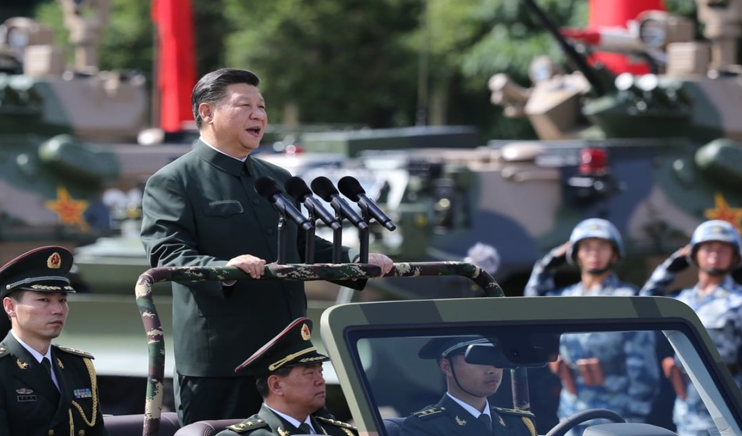
China is witnessing its biggest military purge since the days of Mao Zedong, led by President Xi Jinping. In recent months, many of the country’s most powerful generals including those personally promoted by Xi have been removed, investigated or have simply vanished from public life. The most shocking case is He Weidong, China’s second-highest military officer, who disappeared just three years after Xi fast-tracked him to the top. But the shake-up also raises troubling questions: if Xi cannot trust his own chosen commanders, how strong is China’s military really? As Beijing prepares for a major military parade and looks ahead to its next steps on Taiwan, the world is left wondering whether Xi’s moves show confidence or hidden weakness.
In one of the biggest military changes in China in 50 years, President Xi Jinping has removed or arrested 14 top generals from the People’s Liberation Army (PLA). These generals were all personally appointed by Xi and their sudden disappearance has raised many questions both inside and outside China. This major purge began after Xi Jinping was re-elected for a third term in 2022. Since then, several high-ranking officers have vanished from public view or are reportedly under investigation.
On a cool morning in Beijing earlier this year, China’s top generals gathered for what looked like a simple tradition the annual tree-planting ceremony. But something unusual quickly caught the attention of China watchers: one very important man was missing. That absence sent shockwaves through Beijing and beyond. The missing official was He Weidong, China’s No. 2 military chief and a vice chairman of the powerful Central Military Commission (CMC).
Less than three years earlier, President Xi Jinping had handpicked He for this job, skipping over more senior officers. For He to suddenly vanish suggested something serious: he too had become a victim of a wave of purges that is shaking the Chinese military like nothing seen since Mao Zedong’s chaotic rule ended nearly 50 years ago.
What makes this purge remarkable is that Xi is not targeting the generals of old regimes, as past leaders sometimes did. Instead, he is removing the very people he himself promoted. According to Bloomberg’s investigation, almost one in five generals elevated by Xi since 2012 have since been demoted, investigated, gone missing or been removed. This is unprecedented. By contrast, Xi’s predecessors Jiang Zemin and Hu Jintao never investigated any generals they had promoted. Now, the Central Military Commission, once seven members strong, has been reduced to just four under Xi the smallest leadership group in the post-Mao era.
From the very beginning of his rule, Xi warned that corruption inside the military was an “existential threat” to the Communist Party. Post-buying, bribery and favoritism in promotions were widespread in the People’s Liberation Army (PLA). Families were even known to pay bribes sometimes $16,000 just for a military entrance exam. But recent scandals show the task is far from complete. The Equipment Development Department admitted in 2023 that it had been investigating leaks, bribery and secret cliques going back years. Political and procurement scandals inside the PLA Rocket Force, which controls China’s nuclear missiles, resulted in the downfall of several senior officers.
Xi’s third term, which started in late 2022, has been the most turbulent yet for China’s military. His removal of Defence Ministers Wei Fenghe and Li Shangfu already shocked observers. Now, He Weidong’s disappearance is an even bigger warning sign. For ordinary people, these purges are confusing because the Chinese system rarely explains why an individual disappears. Usually, it becomes clear only when a general skips a public event like the tree-planting ceremony or fails to appear on greeting lists during major holidays. In a system so secretive, a missing face speaks louder than words.
According to UNN Xi will preside over China’s first massive military parade since 2019. Tanks, missiles and fighter jets will roll across Tiananmen Square in a show of strength meant for both domestic and foreign audiences. Yet the big question lingers: does Xi truly trust his generals to fight? This matters not just for China but for the entire world. A military shakeup on this scale hits at the heart of Beijing’s ability to manage conflicts in the South China Sea, along the Indian border and across the Taiwan Strait.
In September, after the parade, China will hold a major Communist Party meeting known as the Fourth Plenum. This gathering will set the direction not just for the economy but also for new appointments to the military leadership. Only four men remain at the top of the military pyramid: Xi himself, the veteran general Zhang Youxia, the graft-buster Zhang Shengmin and the younger commander Liu Zhenli. This is the smallest leadership group since the Cultural Revolution, the period when Mao’s radical policies turned China upside down.
Xi Jinping’s sweeping purge of China’s generals has changed the face of the country’s military leadership in a way not seen for decades. It also reveals deep mistrust inside China’s most powerful institution. A military ruled by fear and secrecy may appear strong in parades, yet uncertain in real battles. For the world, this creates both risk and mystery: China has the largest army on earth but how prepared is it to fight and who really commands Xi’s trust? The success or failure of these purges may define not only Xi’s rule but China’s global future.
About the Author

 Tashi Nima
 Rinchen Tashi