

Tibet’s Ecological Meltdown Exposes China’s Reckless Infrastructure Push at COP30
 Ashutosh Kumar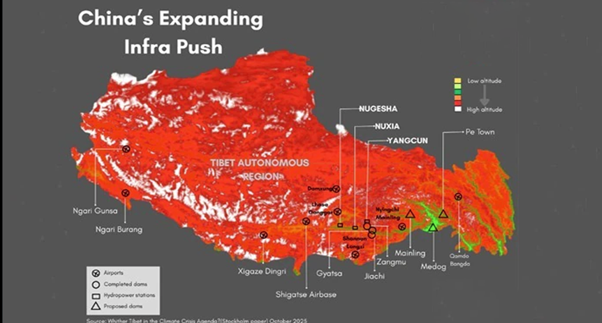
The unfolding environmental crisis in Tibet, known as the “Third Pole” for holding the world’s largest frozen freshwater reserve outside the poles, has entered a perilous new phase. Despite the vast importance of Tibet’s fragile ecosystems, the region’s ecological degradation rarely surfaces at prominent global forums like the UN Climate Change Conference of the Parties (COP). Yet at COP30 in Brazil, experts have raised urgent alarms about the destructive consequences of China’s militarization, hydropower mega-projects, mining, and forced relocations in the plateau, demanding intensified international scrutiny.
China’s aggressive push to reshape Tibet’s environment is fueling profound ecological fallout that threatens the water security of over two billion people downstream in South and Southeast Asia, including India and Bangladesh. This crisis, however, remains largely overshadowed by Beijing’s narrative of green leadership, which focuses on renewable energy investments and high-profile climate summit participation. A revealing new report by the Institute for Security and Development Policy (ISDP) based in Sweden exposes these contradictions and calls for Tibet’s ecological emergency to be recognized at the highest levels of the United Nations and BRICS forums.
Hydropower Megaprojects and Downstream Dangers
Dr. Panda and his colleagues in the paper note, China’s plan to turn Tibet into a hydropower superbase with projects like the Medog mega-dam on the Yarlung Tsangpo (Brahmaputra) is causing major concern. While hailed as a technological triumph costing over USD 160 billion, the dam risks geological instability, landslides, and seismic activity. It threatens to disrupt water flow downstream, impacting millions in India and Bangladesh. Additionally, large dams in Tibet have led to the displacement of local communities, worsening their livelihoods and raising serious environmental and social issues.
Beyond hydropower, Tibet is a centrepiece in China’s race for critical raw materials (CRMs) such as lithium, copper, rare earth elements, and gold minerals vital for the global green economy and tech industries. These extraction activities are carried out with minimal environmental oversight and poor labor conditions, while systematically excluding Tibetan voices from decision-making processes.
The militarization tied to mining operations underscores the fusion of China’s economic ambitions with security imperatives. The People’s Armed Police (PAP) frequently oversee these ventures, enforcing strict surveillance and control. Such a marked securitization further marginalizes local communities and Indigenous knowledge crucial for sustainable stewardship of Tibet’s ecosystems.
From 2000 to 2025, nearly 930,000 Tibetans have been forcibly relocated to make way for these projects or development zones, a displacement trend that deepens social wounds and magnifies the ecological crisis. This large-scale resettlement disregards centuries-old Indigenous land management practices that have been essential for maintaining the plateau’s fragile balance.
According to the Stockholm paper, approximately 75 percent of the Tibetan Plateau is now classified as moderately to severely ecologically vulnerable. The permafrost covering about 40 percent of Tibet is melting rapidly due to accelerated warming, destabilizing both natural ecosystems and the infrastructure built atop them. This permafrost thaw weakens slopes, leading to landslides and disruptions that dramatically increase risks for millions living downstream.
Tibet’s mountains themselves are among the youngest and most tectonically active globally, located at the collision zone of the Indian and Eurasian plates. Constant geological stress creates frequent uplift, crack formations, and seismic events. The intensifying climate change impacts, coupled with relentless development, render this already unstable region dangerously brittle.
India is playing an increasingly positive role at COP30 and in the Third Pole crisis by advocating for transboundary river cooperation, pushing for data-sharing on water flows, and supporting early warning systems for hydrological risks. Indian delegations have highlighted the urgent need for international accountability in Tibet, emphasizing collaboration with downstream nations to protect regional water security and climate resilience. This proactive stance reflects India’s commitment to science-driven solutions, ecosystem protection, and safeguarding the livelihoods of over a billion people dependent on Himalayan rivers.
China’s claims of global environmental leadership at COP30 ring hollow in the shadow of its exploitative infrastructure and resource extraction push in Tibet. The ecological and humanitarian toll driven by hydropower megaprojects, mining, militarization, and displacement demands urgent international scrutiny and pressure for accountability. As the “Third Pole” melts, the future of freshwater security, biodiversity, and social stability for billions in Asia hangs in the balance.
About the Author


 Tashi Nima


 Rinchen Tashi