
India and China: Demography, Power and the Shape of Asia’s Century
 Lobsang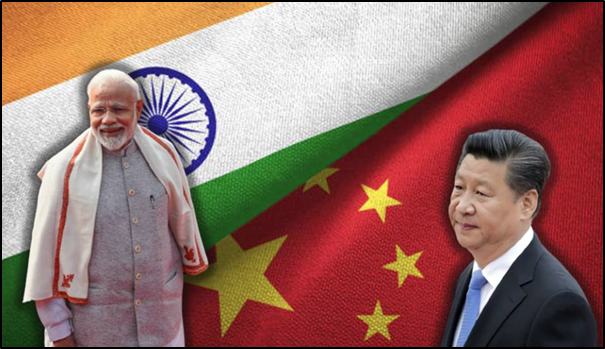
Credit: BING.COM
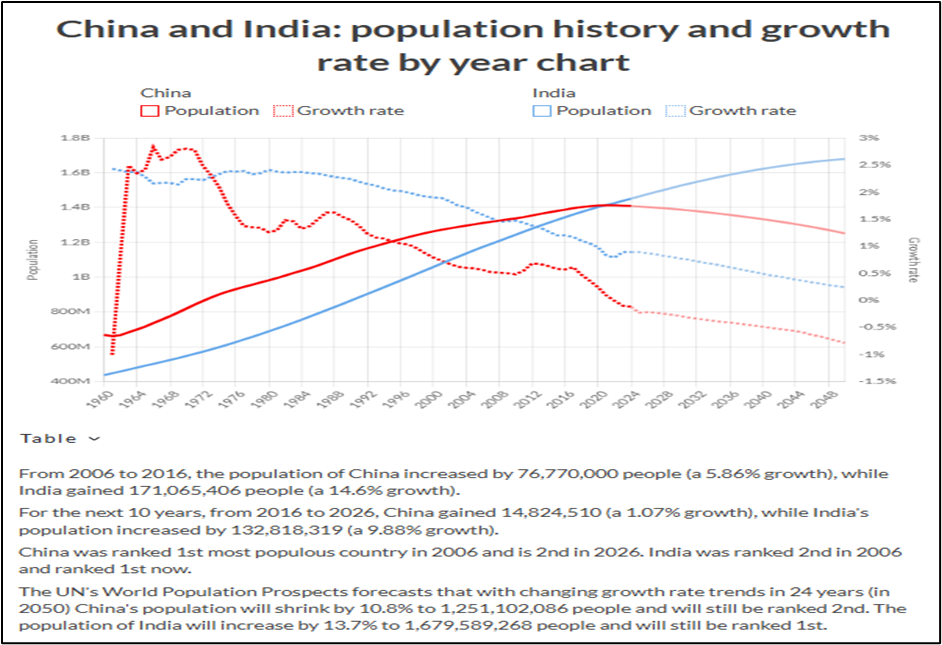
India and China the world’s two demographic giants are entering the 21st century’s decisive decades on sharply diverging population paths. India has overtaken China as the world’s most populous country and will retain that position for the foreseeable future. Yet the true contest is no longer about numbers alone. It is about how each state converts demography into economic strength, military capacity and regional influence. For Beijing, the challenge is managing decline. For New Delhi, it is transforming scale into stability and power without sacrificing democracy or peace.
According to springer report, China’s population is ageing rapidly and has begun to shrink. Decades of low fertility now weigh on its workforce, fiscal capacity and long-term growth. Beijing’s response has been to consolidate its advantages: deep industrial capacity, high urbanisation and strong educational outcomes. These are designed to sustain economic output and military modernisation even as the labour pool contracts. India faces the opposite problem and opportunity. Its population remains young, with a growing workforce that will expand for decades. The Indian state is investing heavily in education, infrastructure and digital connectivity, particularly in historically lagging regions, to ensure that demographic scale becomes productive human capital rather than social strain. Measured through a productivity-weighted labour force an indicator that accounts for education, skills and participation China still leads. But India’s trajectory suggests sustained catch-up as schooling improves and more women and young people enter higher-value work. Crucially, India has time: it can rise without coercive population policies or forced acceleration.
Labour, growth and security to 2100
Long term scenarios reinforce this divergence. If labour participation remains constant, India’s advantage grows slowly. If participation and education converge toward advanced economy levels, India’s workforce becomes both larger and more productive than China’s by late century. Even under pessimistic assumptions stalled education or weak reform India’s demographic edge remains durable. For China, the picture is tighter. Maintaining economic and military reach requires continuous technological gains to offset population decline. Any slowdown in innovation or productivity risks eroding its ability to finance a global reach military and sustain pressure across multiple theatres. Demography, in other words, is not destiny but it sets the limits within which strategy operates.
The Himalayan frontier: people, roads and presence
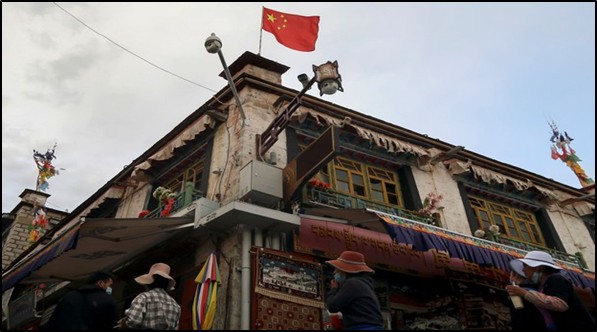
These structural trends are colliding along the India-China border. In the high Himalayas, both sides are racing to strengthen presence in remote frontier regions. China has built hundreds of new border villages, offering incentives for civilians to settle near disputed areas. Combined with roads, surveillance and logistics, these settlements reinforce de facto control and create leverage in negotiations. India’s response has taken a different form. The Vibrant Villages Programme aims to sustain life in frontier communities through housing, roads, power, schools and livelihoods so residents remain by choice, not compulsion. Progress has been uneven, slowed by terrain and democratic process. But infrastructure development along the Line of Actual Control has accelerated, with new roads, tunnels, bridges and airstrips reducing historic disadvantages. The strategic logic is simple: empty borders invite pressure.
Military modernisation under demographic pressure
China’s demographic anxiety has not reduced its military ambition. On the contrary, it is pushing toward capital-intensive, high-precision forces while expanding its Himalayan footprint and Indian Ocean presence. The goal is clear: secure regional advantage before demographic decline deepens further. India is responding selectively. Rather than mirroring China’s model, it is modernising for deterrence strengthening air and maritime power, improving logistics, and integrating tri-service capabilities. Partnerships with like-minded countries add depth, but India remains focused on territorial defence rather than power projection. This balance prepared but restrained reflects India’s strategic culture.
Peace as strategy, not weakness
India’s grand strategy rests on internal stability and regional peace. Democratic legitimacy, pluralism and inclusive growth are treated as strategic assets, not distractions. Policymakers prioritise food, energy and social security alongside defence readiness, ensuring that military strength rests on societal consent. India’s demographic dividend will stabilise the region only if matched by sustained investment in education, health, skills and female empowerment. Numbers alone do not create power; human capital does. Across the Himalayas, the oceans and emerging technologies, India is pushing more coherently than before. It seeks peace where possible, deterrence where necessary, and resilience everywhere. In a century shaped by population shifts, India’s challenge is not to intimidate but to endure, protect and grow. If it succeeds, Asia’s future will be shaped less by fear and coercion and more by confidence rooted in people.
About the Author

 Tashi Nima
 Rinchen Tashi