

Newly Unearthed Temple in Nepal Reveals Ancient Buddhist Pilgrimage Centre
 Karma Ngawang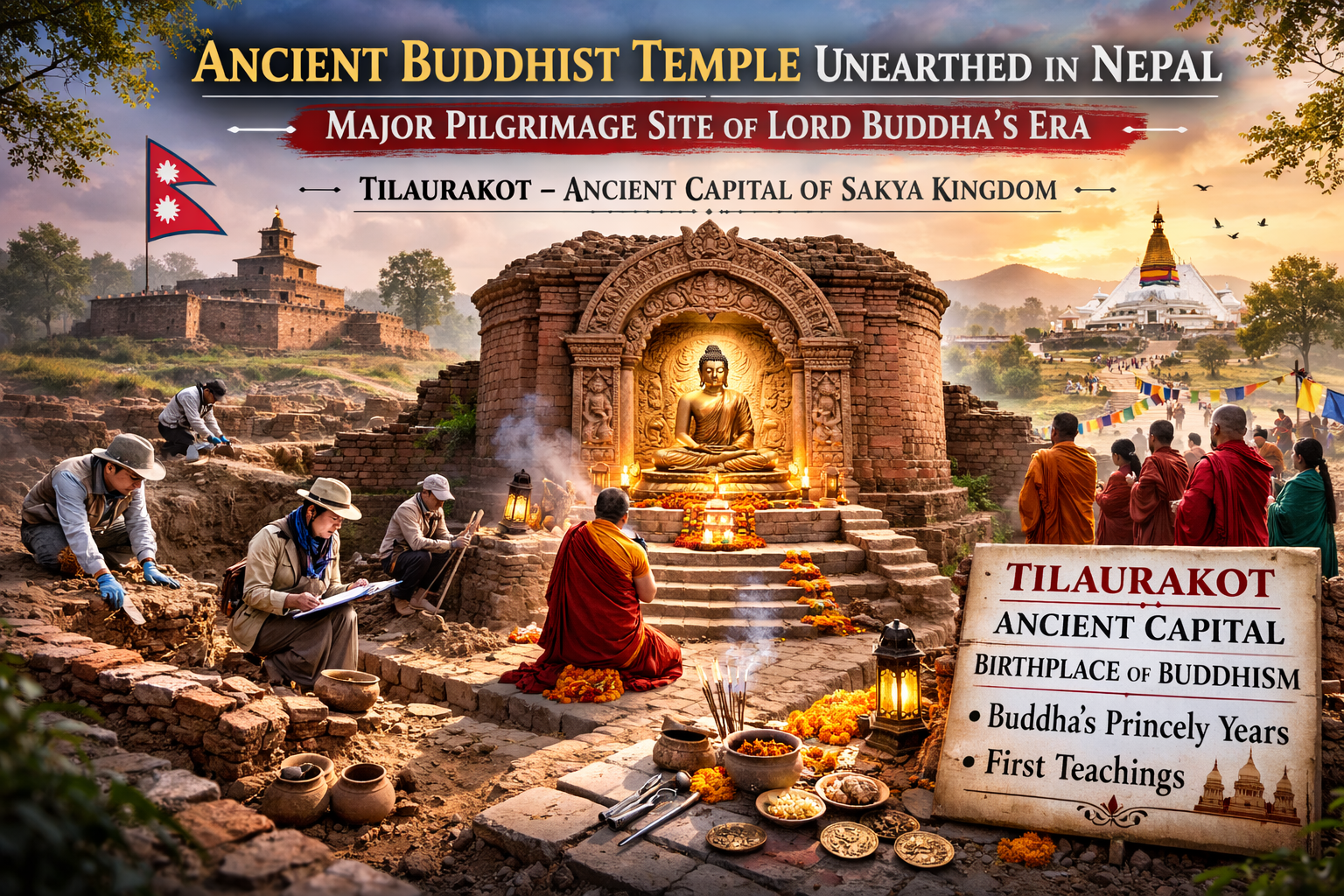
Credit AI Image
A remarkable archaeological discovery in southern Nepal has shed new light on the early history of Buddhism. A newly unearthed temple at Tilaurakot, believed to be the ancient capital of the Sakya Kingdom, is now being recognized as a major Buddhist pilgrimage site from ancient times. This discovery could significantly change our understanding of the religious importance of the region.
Most Buddhists around the world are familiar with Lumbini as the birthplace of Lord Buddha, born more than 2,500 years ago as Prince Siddhartha Gautam. However, Tilaurakot, located just 27 kilometers from Lumbini in present-day Lumbini Province, is believed to be the place where Siddhartha spent the first 29 years of his life before renouncing his royal lifestyle in search of enlightenment.
Recent excavations have uncovered an apsidal temple within the ancient citadel of Tilaurakot. An apsidal temple is a structure distinguished by its semicircular rear wall a design commonly associated with early Buddhist architecture. Archaeologists believe this temple dates back to between the third and fifth centuries AD. Significantly, it is the first structure of this kind discovered in Nepal.
Experts say the temple was built inside a monastery courtyard that had earlier been constructed over the remains of a palatial complex. This suggests that the site evolved from a royal center into an active religious and pilgrimage center after the time of the Buddha.
The excavation team included experts from Nepal’s Department of Archaeology, the Lumbini Development Trust, and Durham University in England. Professor Robin Coningham, a leading South Asian archaeologist and co-director of the excavation, described the discovery as “absolute irrefutable evidence” that Tilaurakot held great religious importance for Buddhist pilgrims in ancient times.
During the excavation, archaeologists discovered stupas, oil lamps, alms bowls, and other religious objects. These items clearly indicate active Buddhist worship at the site. The presence of such ritual objects suggests that pilgrims visited Tilaurakot to honor the Buddha and possibly to remember important events from his life.
Professor Coningham also noted that the apsidal temple at Tilaurakot closely resembles the temple structure at Sarnath in India, where the Buddha delivered his first sermon after attaining enlightenment. This similarity is historically significant because it connects two major locations associated with the Buddha’s life his early years in Tilaurakot and his first teaching at Sarnath. Such architectural parallels strengthen the argument that Tilaurakot was not only a political capital but also a sacred religious center.
Historical records also support this claim. Chinese pilgrims and monks, including the famous Faxian (5th century) and Xuanzang (7th century), traveled through the region and wrote about important Buddhist sites in the area. Archaeologists believe their accounts may describe Tilaurakot, further confirming its role as a pilgrimage destination in ancient times.
Tilaurakot is already considered one of the best-preserved ancient citadels in South Asia. The fortified city measures approximately 500 meters by 400 meters. It was first identified as the possible site of the Sakya capital in 1899 by Indian archaeologist PC Mukherjee. Since then, excavations have revealed ancient roads, shrines, pottery, terracotta figurines, stone artifacts, and coins dating back to the third century BC.
Daya Ram Gautam, a scholar of Buddhist philosophy and campus chief at Lumbini Buddhist University, emphasized the spiritual importance of Tilaurakot. He stated that this is the place where Siddhartha Gautam lived most of his early life and where he returned after becoming the Buddha to deliver a sermon about a year after his enlightenment.
The discovery also has international significance. UNESCO had recently deferred the proposal to include Tilaurakot-Kapilvastu on its World Heritage List. The organization requested more research, precise dating of structures, and stronger evidence showing that the site functioned as a pilgrimage center. Archaeologists now hope that the newly discovered apsidal temple will strengthen Nepal’s case for UNESCO recognition in the coming year.
This breakthrough discovery highlights the deep historical roots of Buddhism in Nepal and offers fresh insight into the life and legacy of the Buddha. While Lumbini remains globally recognized as his birthplace, Tilaurakot now stands out as a powerful reminder of his princely life and later religious influence.
Experts believe that many more relics may still lie hidden beneath the soil of Tilaurakot. Continued excavations could reveal even greater evidence of its ancient religious importance. As research progresses, Tilaurakot may soon gain the international recognition it deserves as one of the most significant Buddhist heritage sites in the world.
About the Author

 Tashi Nima


 Rinchen Tashi