
 Rinchen Tashi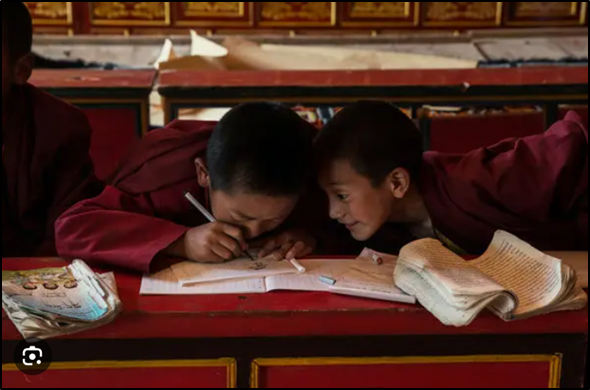
Photo Credit: www.nytimes.com
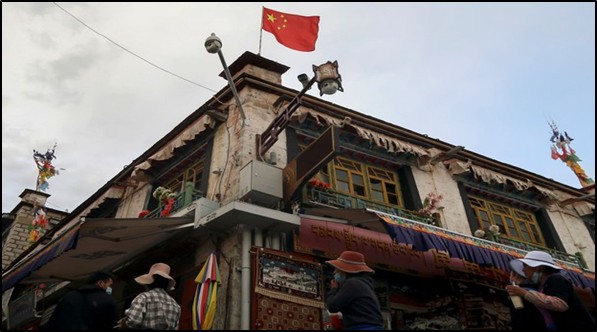
February 21 marks International Mother Language Day, but for the six million Tibetans living under Chinese occupation, it is a day of urgent resistance. Tibetan Language Day is no longer just a celebration of a beautiful, ancient script, it has become a frontline battle against a systematic campaign by the Chinese Communist Party (CCP) to wipe out the Tibetan identity. As we look at the state of Tibet in 2026, the language the very lifeblood of its civilization is facing its greatest threat since the Cultural Revolution.
The Chinese government’s strategy is clear: “One Nation, One Language, One Ideology.” To achieve this, they have implemented policies designed to make the Tibetan language obsolete within a generation. Perhaps the most devastating tool of the CCP is the mandatory colonial boarding school system. Over one million Tibetan children have been forcibly separated from their families and placed in government-run residential schools. These children are immersed in a Mandarin-only environment, leading to a profound linguistic disconnection. By the time they return home, many can no longer hold complex conversations with their parents or grandparents in Tibetan, creating a “generational amnesia” where the oral history of Tibet is being systematically cut off.
Furthermore, under the guise of maintaining “social stability” and fighting “separatism,” China treats the promotion of the Tibetan language as a political crime. The case of Tashi Wangchuk, a humble shopkeeper sentenced to five years in prison for advocating for language rights, highlights that in the eyes of Beijing, speaking up for your mother tongue is an act of war. In recent years, China has also forcibly shut down nearly all informal and private Tibetan-language schools, including those run by monasteries, leaving children with no choice but state-sanctioned Mandarin education. This suppression extends into the digital and religious spheres, Tibetan language apps are censored and AI-driven surveillance flags users who discuss cultural preservation. Because Tibetan Buddhism is inseparable from its language, restricting the script effectively strangles the ability of monks to study sacred texts, thereby “Sinicizing” the religion itself.
This legacy under fire is rooted in a rich history. The Tibetan script was commissioned in the 7th Century by King Songtsen Gampo specifically to translate profound Buddhist philosophy from Sanskrit, creating a literary treasure trove for humanity. Tibetan is recognized globally as one of the most precise languages for discussing psychology and the mind, containing terms for which English or Mandarin have no equivalent. Despite the 1951 17-Point Agreement where China promised to respect Tibetan culture, every decade has seen increased restrictions on these linguistic rights.
The attack on the Tibetan language is a violation of the UN Convention on the Rights of the Child, which states that children should not be denied the right to use their own language. China’s ultimate goal is to turn Tibetans into a loyal, Mandarin-speaking labour force, stripped of their unique history. On Tibetan Language Day, we must amplify the voices that Beijing is trying to silence by advocating for international investigations into boarding schools, educating others on the story of Tashi Wangchuk and supporting Tibetan-led digital archives. The survival of the Tibetan language is not merely a linguistic issue, it is a fundamental test of global human rights and cultural diversity. As the CCP intensifies its efforts to erase the Tibetan identity through forced assimilation and criminalization, the international community cannot afford to remain silent. Preserving this ancient language is essential to protecting the wisdom of the Himalayan plateau and the right of a people to exist as themselves. By standing with Tibetans in their struggle for linguistic freedom, we defend the principle that no government has the right to steal a child’s mother tongue or a nation’s soul.
About the Author

 Tashi Nima