
China’s Attack on Tibetan Exile Elections Reveals Its Fear of Democratic Legitimacy
 Jun Hao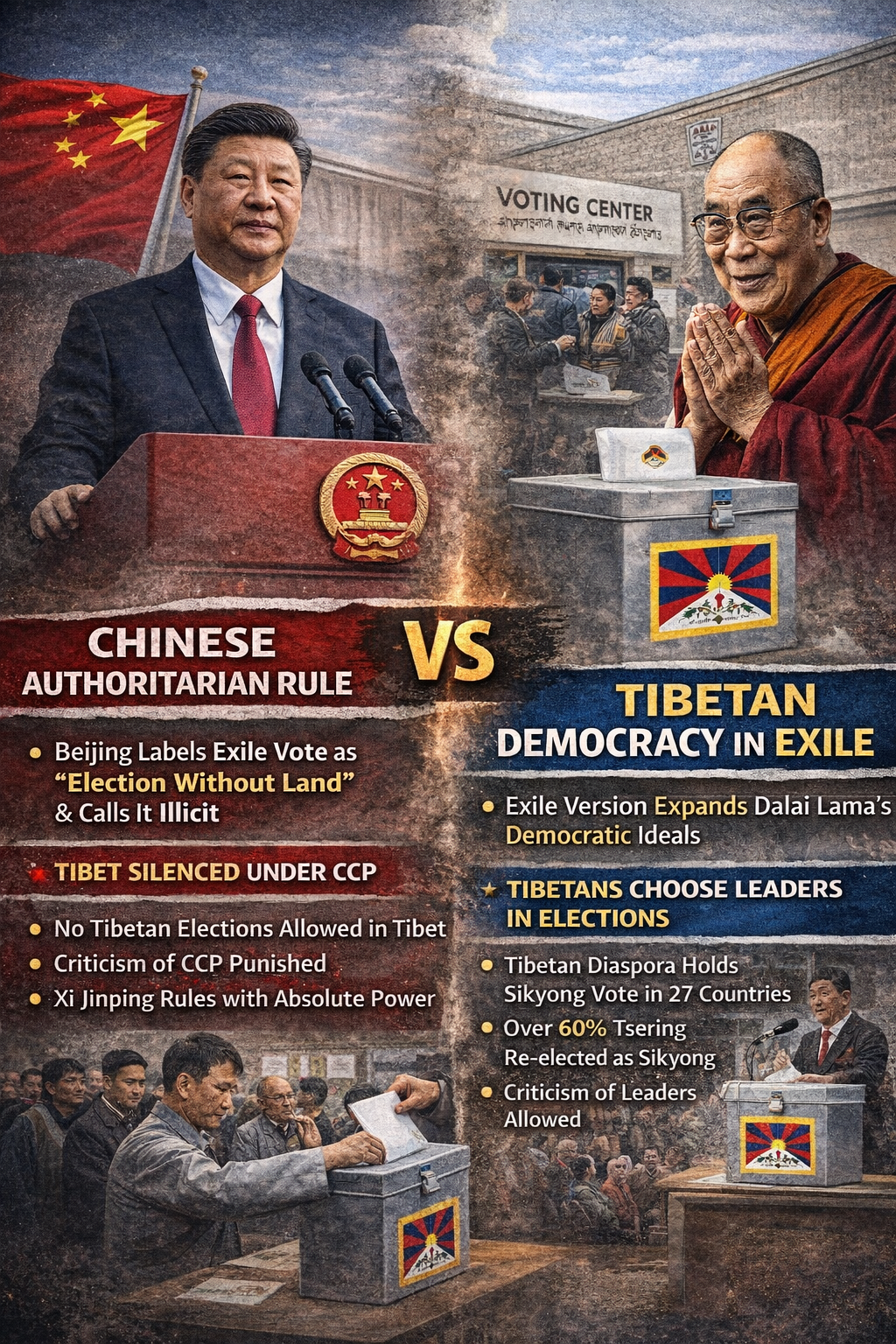
Image Credit : AI
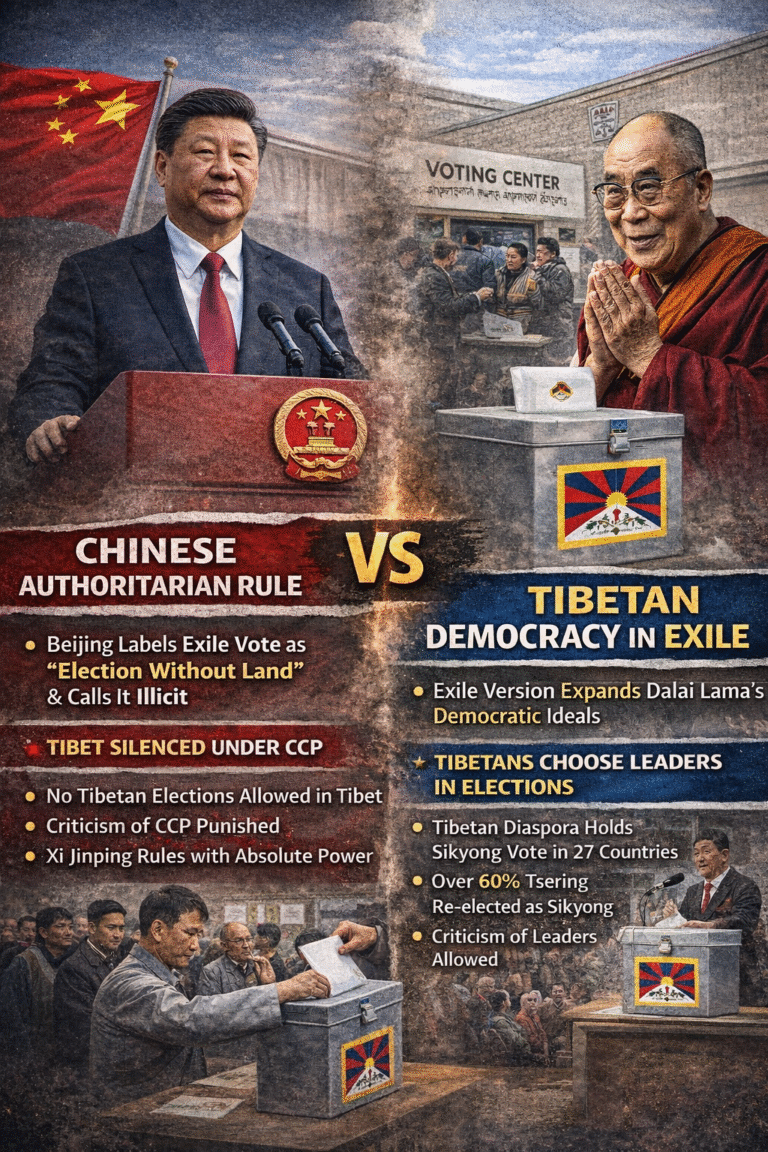
China’s latest attack on the Tibetan exile election is not just another propaganda statement. It is also a reminder of how uncomfortable Beijing remains with any political process that gives Tibetans an independent voice. In an April 7 report, Global Times dismissed the Tibetan exile vote as an “election without a land” and called it an “institutional illusion created by separatist groups in exile.” A day later, Tibetan Review argued that the criticism exposed a deeper contradiction: China was trying to discredit a democratic exercise carried out by Tibetans in exile while offering no comparable right for people inside China to choose the country’s real top leadership.
The election Beijing attacked was not symbolic. It was a structured political process organised by the Central Tibetan Administration, the Tibetan polity in exile based in Dharamshala, India. According to election reports, the 2026 preliminary vote involved 91,042 registered voters worldwide, with 51,140 ballots cast, producing a turnout of 56.17 percent. Incumbent Sikyong Penpa Tsering won 31,325 votes, or 61.025 percent, enough to secure re-election in the preliminary round itself under Tibetan electoral rules. The vote was held across a global Tibetan diaspora spread over 27 countries and managed through local election bodies, showing that the exile system continues to function through institutions rather than slogans.
China’s state media tried to use the turnout figure as proof of weak legitimacy. Global Times argued that 56 percent participation was too low to support the exile leadership’s claim of representation, and compared the vote with the 3.66 million permanent residents of the Tibet Autonomous Region and the more than 6.28 million Tibetans living in China. But this comparison is politically convenient and analytically weak. The exile election is, by definition, a vote conducted among Tibetans living in exile, not among people living under Chinese rule. The relevant question is not whether it includes every Tibetan everywhere, but whether it reflects a functioning democratic practice among the exile community. On that count, the process remains significant.
The larger context also matters. In 2021, the final Tibetan general election recorded 63,991 votes out of 83,080 registered voters, a turnout of 77.02 percent, which the CTA described as the highest in the history of exile Tibetan democracy. That election was conducted across 23 countries and resulted in Penpa Tsering becoming Sikyong. So yes, turnout was lower in the 2026 preliminary round than in the 2021 final round. But a decline in participation does not erase the democratic character of the exercise. In democracies around the world, turnout rises and falls. Debate, criticism, and dissatisfaction with leaders are normal parts of democratic politics, not proof that democracy has failed.
That is where Beijing’s criticism becomes most revealing. Global Times pointed to online criticism from Tibetans in exile to suggest that Penpa Tsering’s leadership lacked credibility and that the system favored loyalty over competence. But public disagreement is exactly what democratic politics looks like. By contrast, China’s own political system is dominated by the Chinese Communist Party, which has maintained a monopoly on power since 1949. As the Council on Foreign Relations notes, ultimate power in China flows from the CCP, and Xi Jinping’s authority comes primarily from his role as general secretary of the party, not from a system of popular national leadership choice. In other words, Beijing is attacking exile Tibetans for practicing open political competition while it protects a one-party system at home.
The real importance of this episode is not only what China said, but why it said it. The sharp language used by Chinese state media suggests that Tibetan exile elections still carry symbolic power internationally. They show that even without territory, a displaced people can maintain institutions, hold votes, debate leadership, and preserve political identity. That does not solve the Tibet issue, but it does challenge Beijing’s effort to define Tibet solely through state control. China may call the exile election an illusion, but the facts show a living political process that continues to give Tibetans in exile a democratic voice.
About the Author