
China’s 15th Five-Year Plan in Tibet: Development on Paper, Deeper Control in Practice
 Jun Hao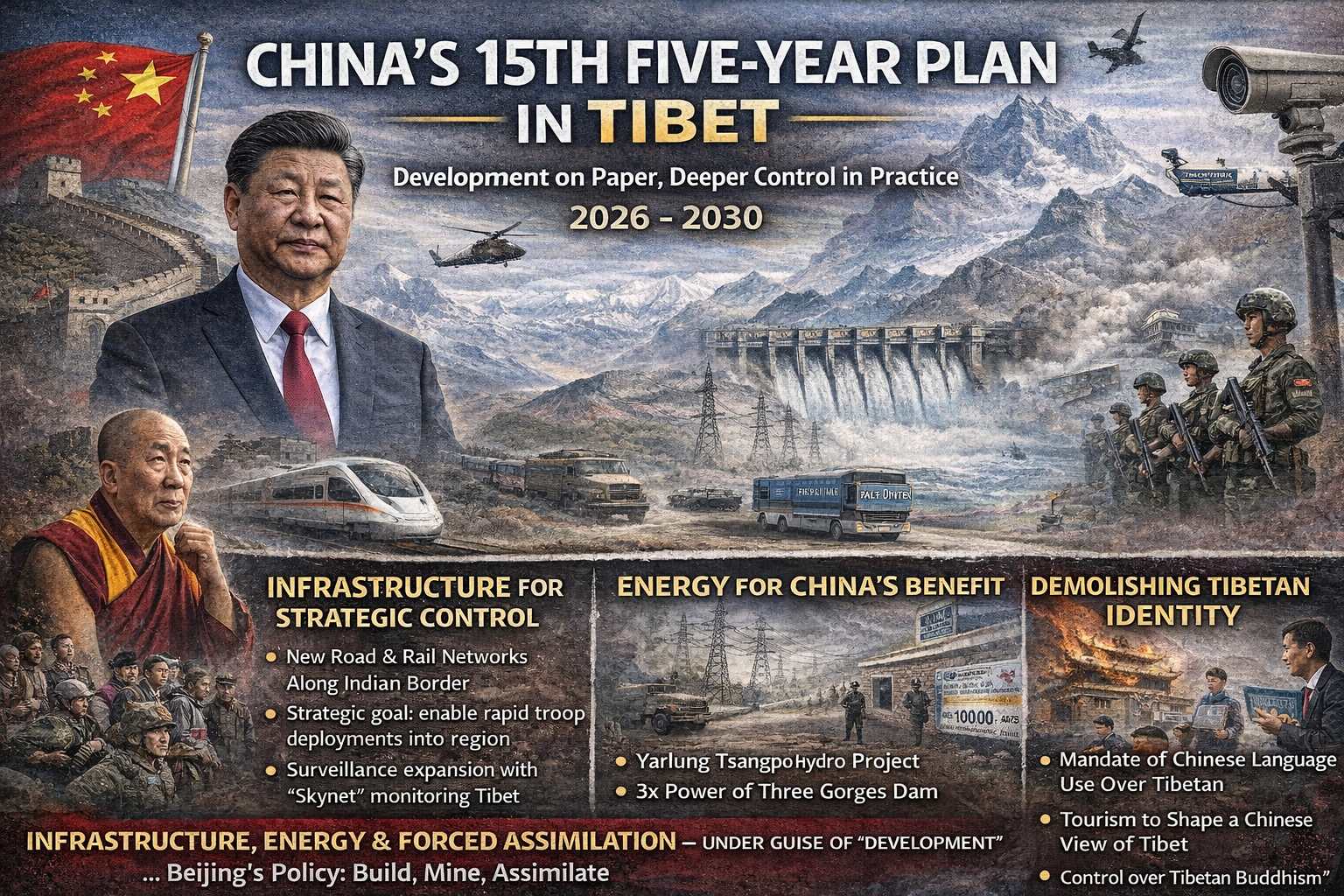
China’s 15th Five-Year Plan, covering 2026 to 2030, was approved by the National People’s Congress on March 12, 2026. On paper, the plan is part of Beijing’s larger push for “high-quality development” and its long-term goal of “socialist modernization” by 2035. But in Tibet, the details point to something more political than developmental. According to the International Campaign for Tibet, the Tibet-related sections place security, assimilation, and tighter state control at the center of policy. The plan’s Tibet chapters were also aligned with provincial-level subplans, showing that Beijing wants local implementation to follow the national line closely.
The most striking feature of the Tibet sections is that they do not unveil a radically new development vision. Instead, they largely continue and deepen existing projects in transport, energy, surveillance, and political integration. ICT argues that these projects serve a dual purpose: they can produce economic output, but they also strengthen national security and accelerate the forced integration of Tibetans into a CCP-defined national identity. That is why phrases like “Chinese-style modernization” and “forging a strong sense of community for the Chinese nation” matter so much in the text. They are not only economic slogans; they are political instructions.
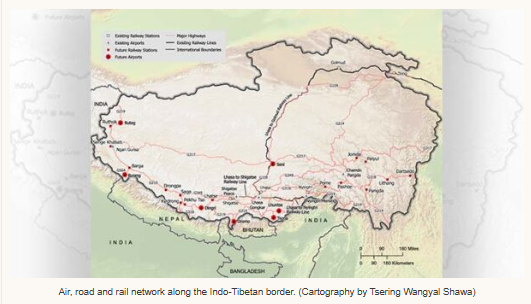
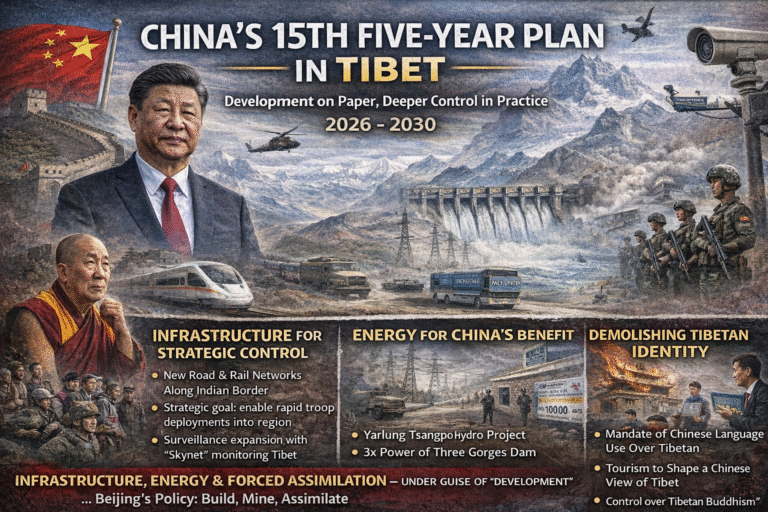
Transport infrastructure is a clear example. The plan advances rail links from Ya’an in Sichuan to Nyingtri in Tibet, work on the Xinjiang-Tibet Railway, and upgrades to key sections such as Golmud-Lhasa. It also pushes major highway projects, including G219, G109, G317, and G318. These routes run across or near Tibet’s sensitive border zones with India and Nepal. Analysts at CSIS warn that new and under-construction rail lines near the Indian border could also support rapid military deployment during a crisis along the Line of Actual Control. In other words, roads and railways in Tibet are not just about trade or tourism; they also strengthen Beijing’s strategic position in a contested frontier.
Energy is another major pillar of the plan. The most controversial project is the Yarlung Tsangpo hydropower scheme in Nyingtri, which ICT says is designed around five cascade stations and could generate about 300 billion kilowatt-hours of electricity a year, roughly three times the output of the Three Gorges Dam. The concern is not only environmental. The plan explicitly links Tibet to west-to-east power transmission, meaning much of the electricity is meant to serve demand outside Tibet, especially in eastern China. Jamestown Foundation research adds that the broader project is tied to Beijing’s energy and computing strategy, including data centers and AI infrastructure. One estimate cited by Jamestown says the Yarlung project could create more than 100,000 jobs, with over 60 percent in technical roles, raising the prospect of a large influx of outside workers into Tibet.
This matters because Beijing presents such projects as development for Tibetans, but the pattern suggests that Tibet is increasingly being treated as a resource and logistics base for the wider Chinese state. The same logic appeared earlier under the 14th Five-Year Plan. In 2022, official Chinese figures said the Tibet Autonomous Region would invest 140.4 billion yuan, about $22 billion, in 181 projects spanning railways, highways, airports, clean energy, tourism, and border trade logistics. The 15th plan does not mark a break from that model. It reinforces it. The core message is continuity: build more infrastructure, move more power, deepen more integration.
The plan also makes clear that security is inseparable from development in Beijing’s Tibet policy. ICT highlights how the national plan calls for stronger national security systems, while Tibet-related plans pair this with language about fighting separatism. It also points to continued expansion of the “Skynet Project,” China’s AI-supported surveillance system. Georgetown’s Center for Security and Emerging Technology has noted that Chinese state media has made sweeping claims about Skynet’s reach and accuracy, even as technical limits remain. The larger point is that digital infrastructure in Tibet is not neutral. It is part of a system designed to monitor, deter, and discipline.
Assimilation is not hidden in the plan; it is written into it. ICT notes that the Tibet Autonomous Region plan calls for students, village cadres, farmers, and herders to become proficient in the “national common language and script,” meaning standard Chinese. The same documents promote ideological campaigns such as “Red Gene” inheritance and repeat the line that Tibet has been part of the Chinese motherland since ancient times. The plan also goes beyond language and history into religion. It supports the Sinicization of Tibetan Buddhism and repeats Beijing’s position that the reincarnation of major lamas should follow procedures controlled by the Chinese state. That is not a minor bureaucratic detail. It goes directly to the heart of Tibetan spiritual life and the future of institutions linked to the Dalai Lama.
Tourism, border trade, and regional openness are presented as modern growth strategies, but even here the political purpose is visible. The Tibet plan speaks of turning Tibet into a gateway to South Asia and strengthening trade corridors near Nepal and, indirectly, India. It also says culture should promote tourism and tourism should promote culture, while calling for “distinctive Chinese cultural characteristics” in visual and symbolic projects. This suggests that tourism is being used not simply to earn revenue, but to reshape how Tibet is represented, consumed, and politically understood.
Taken together, the 15th Five-Year Plan shows that Beijing’s Tibet policy is not mainly about improving Tibetan self-rule, protecting Tibetan identity, or giving Tibetans more control over their future. It is about building infrastructure that serves national strategy, extracting energy and logistical value from the plateau, tightening surveillance, and folding Tibetan society more deeply into a Chinese political and cultural framework. The language of development remains important because it makes the policy easier to sell. But the structure of the plan shows a harder truth: in Tibet, development is being used as the vehicle for control.
About the Author